
























- Tips on machining 2017/04/27 UP
-
Tips on machining vol.8
Successful Chip Control in Turning

- Tag
-
- Chip disposal
- Turning
Turning is a successive cutting process in which the tool tip is in constant contact with the workpiece. So it tends to produce long, continuous chips, which are likely to get tangled in the rotating workpiece. The tangled chips may cause scars on the finished surface or require the operator to remove them. Moreover, operators sometimes get injured during chip removal. Thus, long, tangled chips can be a main factor that decreases machining quality and hinders automation and safe operation.
It is said that chip control is a never-ending issue for machine tool operations. The most effective solution is to break chips into small pieces properly in any cutting environment and condition. Here are some examples of chip breaking methods.
1. Chip control by chip breaker
A chip breaker breaks chips by means of the dimples and unevenness on the rake face of the tool. Breakable chip sizes vary depending on the shape and type of the chip breaker, so it is important to select a chip breaker appropriate for each chip size that relies on cutting conditions.
When a dedicated tool is used, proper chip breaking can be achieved by creating a chip breaker suited for the chip size.
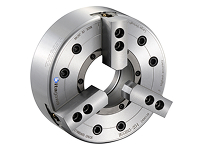
However, there are problems specific to I.D. machining: chips get stuck in the machined hole or accumulate in the gap between the chuck and the workpiece during through-hole machining even after those chips are successfully broken into small pieces. In these cases, chips can be removed by high-pressure coolant or compressed air, and chip accumulation can be avoided by a larger opening between the chuck and the workpiece.
2.Chip control by cutting conditions
One of the cutting conditions that has a significant impact on chip control is “feed per revolution.”
In order to make a chip breaker function well, chips should be thick. The thickness of chips generated during turning operation relies on feed per revolution. This means chip breaking will become easier if feed per revolution is increased. However, It must be noted that excessively large feed par revolution can increase cutting resistance, causing the tool tip to get chipped.
3. Chip control by program
Slight pauses in cutting motion, such as step feed and dwell, are also effective for chip breaking. For example, in grooving, where long spiral chips are usually formed instead of small broken chips when a continuous feed motion is generated, if step amount is set to about 1 mm, chips can be broken periodically. A recent chip breaking technology that utilizes low-frequency oscillation can produce a similar effect through program configuration. Please contact us if you are interested in this method.
4.Chip control by high-pressure coolant
Accurately spraying high-pressure coolant (with a pressure of approx. 14 MPa) at the cutting point has proved effective in breaking chips of sticky materials such as stainless steel, titanium, Inconel and low-carbon steel. This method can also be applied to steel and aluminum alloy chips.
Additionally, there is an example showing an excellent cooling effect of high pressure coolant on the cutting point. When Inconel, which is usually machined at a cutting speed of about 30 m/min, is machined at 70 m/min, a tool life similar to that at 30 m/min can be achieved. High-pressure coolant is also effective in increasing machining efficiency. Conventionally, the costly high-pressure coolant device has been used mainly for materials with high added values. Today, various efforts are being made to expand the application of the high-pressure coolant while reducing facility costs. For example, the coolant discharge amount, flow rate and a point where coolant is sprayed are optimized to achieve effective chip breaking of a low-carbon steel material or a workpiece with a small cutting allowance.


Please feel free to consult with us for any questions or concerns you may have about chip control.
- Relevant contents