



















- Tips on machining 2022/02/21 UP
-
Tips on Machining Vol. 29
Tips for making die casting molds with cooling pipes using DED method

- Tag
-
- Additive manufacturing
- Additive manufacturing machine
- Die&Mold
Die casting molds are a type of mold used in the die casting method for molding metal. As its name implies, die casting is a casting method during which aluminum or brass is melted and injected into a precision mold under high pressure. Because components are molded under high pressure, the metal can be injected uniformly throughout the entire mold. This process makes it possible to manufacture thin, complexly-shaped die cast products with high-grade surfaces at highly precise dimensions. Once a mold is made, a continuous, quick casting cycle is possible, making this process perfect for mass production.
On the other hand, die cast products experience volumetric shrinkage during cooling after the casting process, resulting in gas porosities and cracks due to internal stresses. Although this is a common phenomenon among die cast products, it can be prevented by cooling the mold during the casting process. To do so, pipes that carry cooling water are built into the mold to maintain a consistent internal mold temperature. In general, cooling pipes are drilled into the mold. However, additional time is required for this due to high-precision cutting technology necessary for making pipes in line with complex mold surface shapes and for additional setup changes. With this in mind, additive manufacturing technology (hereafter referred to as "AM technology") has been established as of late to create built-in cooling pipes along the molding surface inside the mold. Today we will be taking a look at some tips for machining cooling pipes for die casting molds using this AM technology.
Making conformal cooling channels
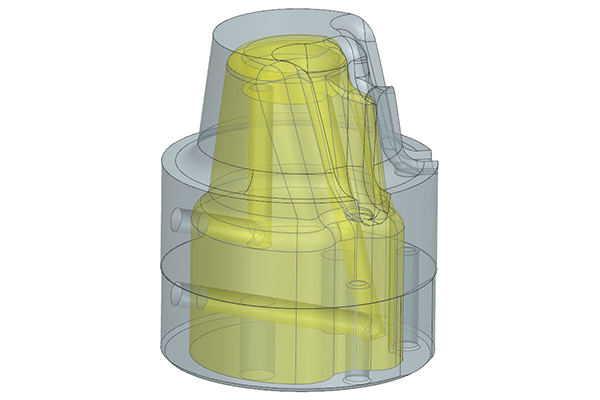
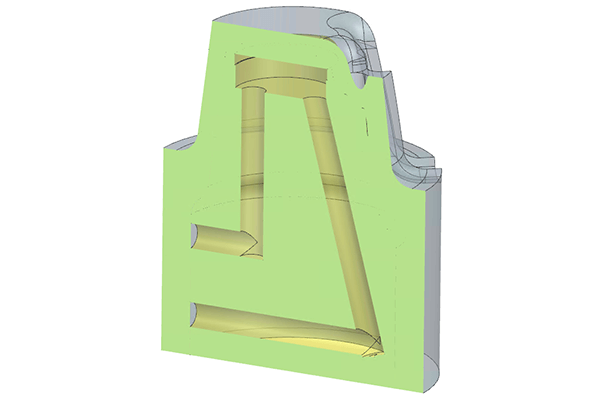
The cooling pipes along the surface shape of the molded product inside the mold are called conformal cooling channels. Utilizing AM technology, it is possible to create the ideal conformal cooling channels in any form to match the molding surface of complex mold shapes. Doing so improves mold cooling efficiency.
Sprue core conformal cooling channels
Now we will go into a bit more detail on AM technologies. Many machining methods utilizing AM technology have been invented in recent years, but here we will take a look at the three main methods. There are the directed energy deposition method (DED method), in which powdered metal supplied by a nozzle is fused using a laser and then deposited, the powder bed fusion method (PBF method), in which a laser is used to fuse a bed of powdered metal for deposition, and the binder jetting method, in which a resin is deposited on a bed of powdered metal.
The PBF method is frequently used in the creation of conformal cooling channels. It is excellent for creating complex channels on the inside of molds. Although we have experience making conformal cooling channels via the PBF method, there are certain challenges, such as the long manufacturing time and our lack of expertise in shaping high hardness molding materials. For these reasons, we do not believe that the PBF method is always the optimal way to create conformal cooling channels. So, what about making conformal cooling channels via the DED method?
Main AM methods

Making conformal cooling channels via the DED method
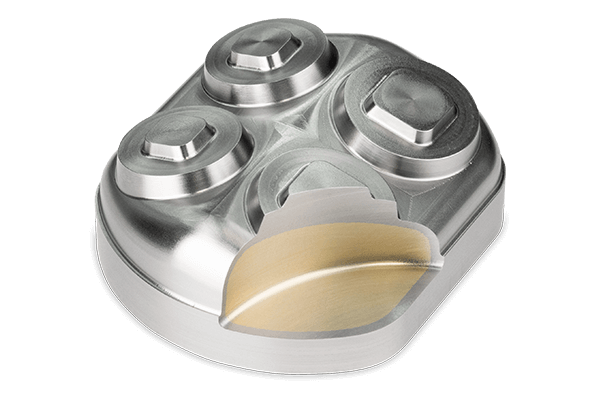
Unlike cutting and the PBF method, different types of powders can be combined to make molds in the DED method. Utilizing this technique, different powders can be used for each part of the mold according to the application. For example, the core section (center), through which the cooling line passes, can be made of high thermal conductivity copper alloys, and high hardness tool steel can be used on molding surface (surface) where abrasion and corrosion resistance is required. For such applications, optimization of formation conditions is vital to ensure that the same deposition height is achieved for all materials, and so that the area where two different materials intersect does not become separated. We use our knowledge in such areas when presenting solutions to customers.
By varying the materials according to different parts of the mold, it is possible to make high hardness molds that perform better than die casting molds with conformal cooling channels made by cutting or the PBF method.
Conformal cooling channel production case studies
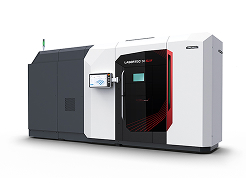
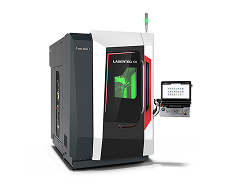
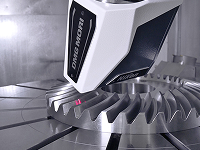
At Fuji CO., Ltd.(Kawaguchi City, Saitama), the DMG MORI LASERTEC 65 DED hybrid is being used to produce molds with improved cooling efficiency. As previously mentioned, copper alloys with a high level of thermal conductivity are used in mold core sections, however, in this case, the core section shape could be cut, so the core is made by machining blocks of materials. Because cutting is faster and produces higher precision results, shaping and cutting can be used depending on the shape, or alternately, which is a major feature of the LASERTEC 65 DED hybrid. Later, the interior of the cut core is drilled to create cooling pipes, and high-hardness mold steel Ferro 55 is molded on top of the core with a cut finish. Because a Ferro 55 hardness of HRC-55 can be achieved by molding alone, this method reduces heat treatment processes.
Cylinder head mold
This concludes the explanation of tips for machining die casting molds with cooling pipes utilizing the AM DED method. Not only are cutting techniques improving at a steady progress in the world of manufacturing, but additive techniques are as well. We have a wealth of experience in making improvements utilizing different mold machining and AM techniques. Please feel free to contact us to improve your existing machining methods and if you need assistance with additive manufacturing or other new machining methods.