






























- Tips on machining 2018/07/09 UP
-
Tips on machining vol. 22
Solutions for 3 major problems of finishing operation 【End milling】

- Tag
-
- Milling
- Finishing
Key requirements for successful finishing operation are “dimensional accuracy” and “surface roughness”, as well as “stability (or repeatability of machining accuracy)” in case of mass-production. Many customers, however, find it challenging to achieve required dimensional accuracy, surface roughness, and stability with an end mill.
3 main obstacles to achieve required dimensional accuracy, surface roughness, and stability are: 1) wear of cutting edge, 2) deflection of an end mill, and 3) chatter vibrations. In other words, avoiding these problems or predicting them and taking appropriate countermeasures in advance will greatly contribute to reduction of machining time.
In this article, we would like to provide some solutions for the 3 major problems of finishing operation by an end mill.
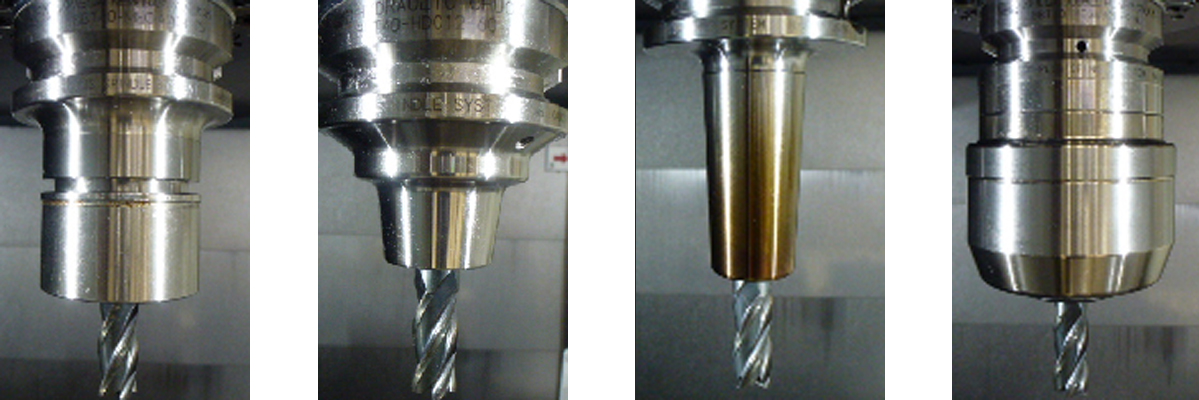
Variation of tooling to hold an end mill
From left to right: collet chuck, hydro chuck, shrink-fit chuck, milling chuck

Finishing surface of side milling
Wear of cutting edge: Use an end mill with a higher number of teeth and reduce the cutting volume per tooth to avoid wear of cutting edge, provided that the cutting volume per revolution remains the same. In milling operation, change the contact position of the cutting edge to the workpiece and use the cutting edge in its entirety. In this way, you can avoid excessive partial wear of cutting edge.
Deflection of an end mill: Use an end mill with wide core diameter and short overhang to avoid deflection. Select an end mill with a higher number of teeth, then you will find an end mill with wider core diameter. In this case, however, make sure to change the cutting conditions to reduce the cutting width, because an end mill with a higher number of teeth has limited space for chip evacuation.

Information provided by NACHI-FUJIKOSHI CORP.
Chatter vibrations: One of the ways to avoid chatter vibrations is to keep dimension and feature of finishing allowance constant. If finishing allowance is not constant, for example due to chatter marks caused by rough machining and semi-finishing left on the surface, cutting resistance acting on an end mill continues changing, and this may result in chatter vibrations. Please make sure to eliminate chatter marks before finishing operation, and pay attention to adjust roughing tool path to create constant finishing allowance.
Selecting an appropriate tool holder is another key point. Use a milling chuck for heavy cutting, and a collect chuck or hydro chuck for thin and speedy machining. Some high-rigid tool holders are compatible with end mills. Choose a tool holder that absorbs tool runout. Check the degree of runout before machining.
Special attention is required at finishing operation of corners. Avoid machining the bottom and the side of a workpiece at the same time as it generates large cutting resistance that may lead to chatter vibrations. Instead, separate the two operations to avoid chatter vibrations, for example by machining the bottom first, raising the position of the end mill by several μm, and then machining the side of a workpiece.
These are 3 selected examples to solve problems at finishing operation by an end mill. We have many more ideas to solve similar problems by tooling and tool path. Please contact DMG MORI to talk about your challenges.