








- Tips on machining 2017/09/08 UP
-
Tips on machining vol.11
More profit with fewer tools
ーDisadvantages of increased number of tools and solutions to reduce the numbersー

- Tag
-
- Tool
- Tool management
Manufacturers of industrial products have successfully reduced the number of components through low-cost design. At the same time, however, they are facing increased difficulty in machining due to more and more complex workpiece shapes. On many shop floors, machine operators are required to use a variety of cutting tools to deal with diverse shapes. So ever-increasing tools may be one of their biggest headaches.
In this article, we will visualize disadvantages of increased number of tools and discuss the ways to reduce their numbers.
The increase in the number of tools carries the following disadvantages: (1) increase in tool management burden, (2) deterioration of machining accuracy, and (3) prolonged machining time.
(1) Increase in tool management burden
This has been a deep-rooted issue. You can easily imagine that the increased number of tools makes their inventory management cumbersome. But the management burdens are not limited to tool inventory; it also involves tool life, machining conditions, number of holders, setup times and storage space.
This can be likened to an iceberg on the sea. The issues that we can see are just the tip of the iceberg. There's a lot more under the surface, which may increase both man-hours (labor cost) and overhead cost, possibly leading to a decrease in the profitability of the shop floor as a whole.
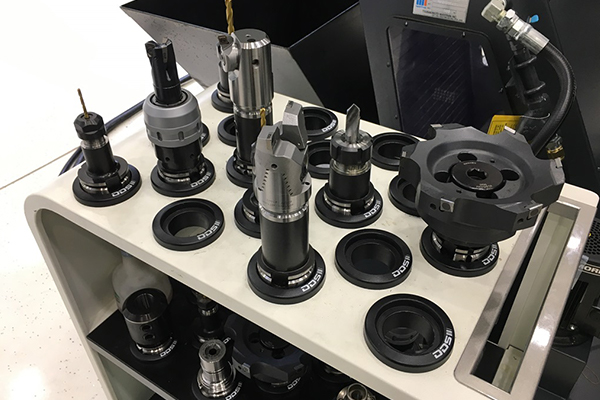
Varieties of tools left on the tool wagon
(2) Machining accuracy
The use of multiple drills to machine holes with different diameters can lead to deterioration of machining accuracy (coaxiality), as a result of a shape error of the drills, positional deviation of the tool tip at the time of tool change, and motion error of the machine.
(3) Machining time
The increase in the number of tools necessitates an increase in the number of magazines, which involves longer tool change time and higher change frequency. Frequent tool changes could boost the likelihood of unexpected troubles or mistakes such as adhesion of chips to tool holders and attachment of wrong tools. As a result, overall machining time becomes longer.
Thus, it can be said that an increase in tools has a greater impact on machining cost increase than you might realize. Put another way, you can aim for an ideal production environment by solving this problem.
One of the ways to reduce the number of tools is using a multi tool. The multi tool is a collective name for cutting tools capable of handling multiple machining processes alone, which includes step drills, chamfer drills and tap drills. For example, if a step drill is used for machining with one tool path, it can achieve superb machining accuracy with no axis deviation. Once machining accuracy is stabilized, you can omit or reduce measurement/inspection processes, thereby cutting down on machining costs.
The use of a multi tool, instead of several different tools, not just solves problems caused by increased number of tools, but simplifies operation procedures and the QC process chart. It also helps reduce operators’ workload, which leads to prevention of setup errors (careless mistakes).
Step drill
Multi-step boring tool
However, multi tool also have some issues to be considered, such as tool rigidity and tool path generation methods, and these might make you hesitate to use.
DMG MORI provides technical support for customers facing machining challenges. So, please feel free to consult with us for any questions or concerns you may have.