
















- Tips on machining 2016/09/26 UP
-
Tips on machining vol.1
Tips on chucking easily-deformed workpieces
-How to hold low-strength whorkpieces-

- Tag
-
- Fixture/chuck
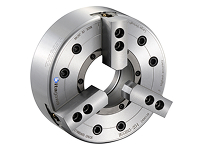
When a workpiece is machined on a turning center (lathe), a fixture called “chuck” is used to hold the workpiece. The chuck holds/releases the workpiece by closing/opening its jaws. There are several types of jawed chucks, which are differentiated by what types of power they use to open/close the jaws: some use a mechanical means such as a screw, taper or disc spring, and some use the diaphragm method (a mechanism which utilizes a fluid) including a hydraulic or pneumatic system, and others rely on magnetic or vacuum force.
Among them, the hydraulic chuck is the most commonly used. However, it has also a disadvantage: excessive gripping force causes workpiece deformation, which consequently leads to the decrease in circularity. This is much more likely to occur if a hollow, thin-walled workpiece is chucked. For instance, when a hollow, thin-walled workpiece is held in a three-jaw chuck, the points where the jaws grip get dented, causing the workpiece to have a triangular cross-section (see Figures).
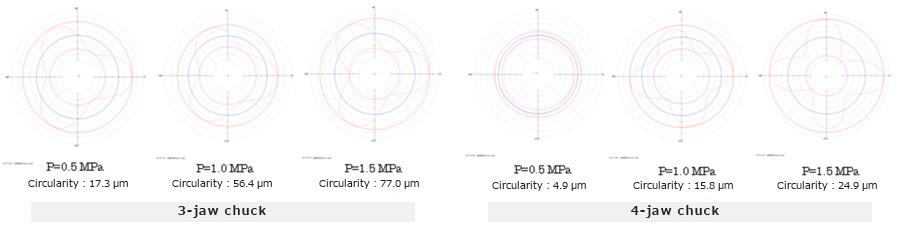
Figures: Comparison of I.D. circularity of hollow workpieces (by number of jaws)
The important point to hold a thin-walled workpiece without deformation is to minimize the contact pressure per unit area at the jaw gripping points. More specifically, if a chuck holds the workpiece not by point contact but by surface contact, the force that acts on the workpiece can be reduced even though gripping force is the same. As a result, workpiece deformation can be minimized. Take women’s high heels as an example. If a woman wearing high heels accidentally steps on your foot with her toe (i.e. force acts on a larger surface area), it is not too much pain. But if she steps on with her heel (i.e. force acts on a smaller surface area), it could be very painful. This means that although her weight is the same, weight (force) distribution will change depending on the area over which her weight acts.
There are some ways to increase the contact area with the workpiece: making original soft jaws, or employing a collet chuck (mandrel chuck) or a fixture. If you think about using soft jaws, it is important to make the jaws in such a way that they are approximately 0.02 mm smaller than the workpiece O.D., so that the jaws and the workpiece can make a surface contact. You can also increase the number of jaws (photo: 4-jaw chuck) or add two jaws to a one-jaw chuck.
The collet chuck, which holds a workpiece by surface contact, is one of the effective means to suppress deformation. However, it is not suited for automated production lines because its narrow gripping range makes it difficult for a robot to attach/detach workpieces. A fixture is also suitable for suppressing deformation but it costs a lot to make. Other effective ways to suppress deformation include: inserting a core into the hollow center of the workpiece (to increase workpiece rigidity); fixing the workpiece in an axial direction by means of a center or the like (to hold the highly rigid part of the workpiece); and repeatedly conducting turnover machining to adjust the gripping force to workpiece rigidity.
4-jaw chuck
We at DMG MORI have accumulated a wide range of machining solutions through our long-term experience in customer support. As for workpiece holding, varieties of chucks from manufactures both in Japan and abroad are on display in our showroom, where our experienced machining engineers offer technical support and chucks useful for solving your machining challenges. Please feel free to consult with them for any questions or concerns you may have.