

- Ví dụ về trường hợp khách hàng 2018/04/05 UP
-
Machine operators at the cutting-edge factory work on an annual salary
Introducing a work style that allows workers to leave work on time every day
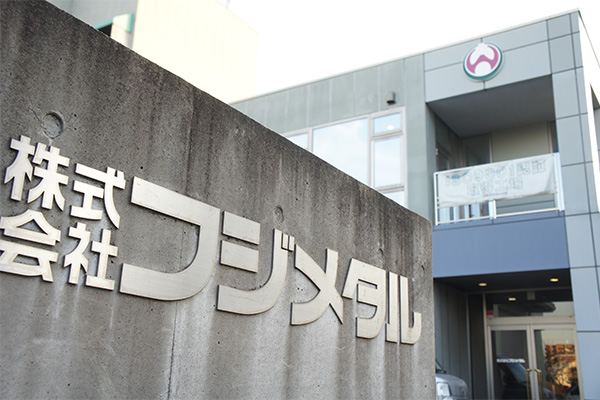
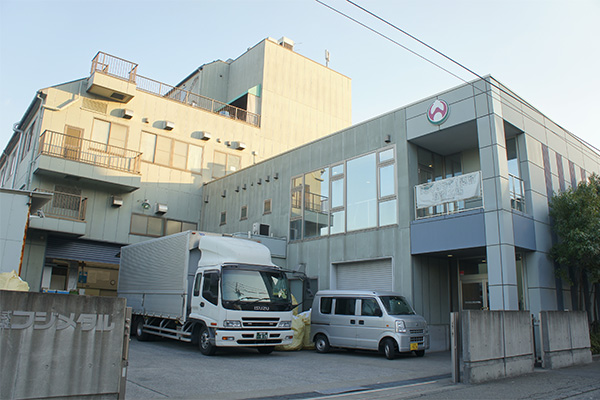
Fuji Metal Co., Ltd. Headquarters Building (Kawasaki City, Kanagawa)
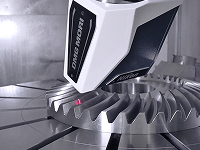
Fuji Metal specializes in the machining of nonferrous metals. The majority of the company’s sales comes from the manufacture of target materials used in sputtering equipment, which are vital for the manufacture of semiconductors. Sputtering refers to a process whereby film is deposited onto a semiconductor, which requires the use of a broad range of target materials, including titanium, copper, tantalum and cobalt, depending on what is to be coated. This requires specialist machining know-how in handling materials that can be particularly hard, adhesive, or fragile when compared to iron and other common machining materials. This is a field in which Fuji Metal has carved out an unrivaled position.
The company established new factories near its headquarters every two years in recent years, with its seventh factory equipped with state-of-the-art facilities just completed. Even so, the number of orders the company receives continues to outpace this growth. “Recently we are seeing demand double our expectations,” reveals Fuji Metal President and Representative Director, Mr. Masatoshi Fujii.
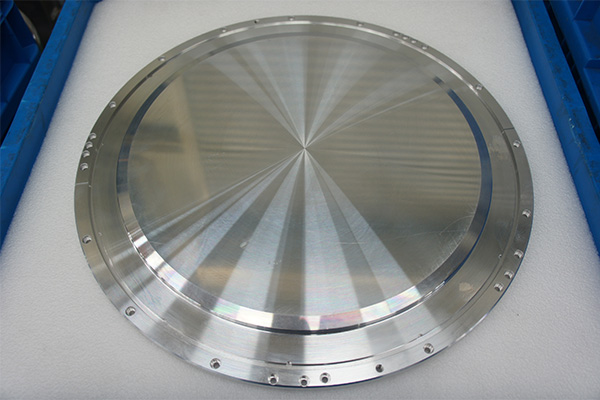
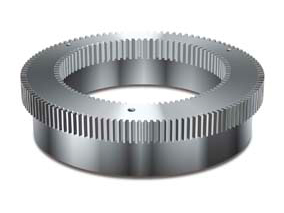
Sample workpiece with target material
The company raised the salaries of operators working at the cutting-edge factory by employing the annual salary system. An overtime pay of two hours is included in their salaries regardless of whether the equivalent work is performed or not. By implementing unmanned operation during night hours and on the weekend, the company has been able to send its workers home at the regular shift end time of 4:45 PM without issue.
How was Fuji Metal able to achieve such staggering levels of productivity?
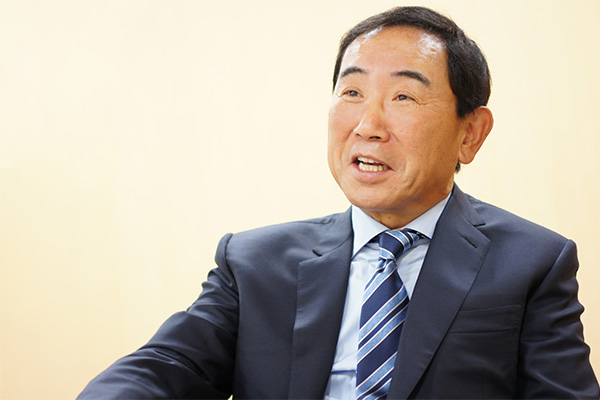
President and Representative Director, Mr. Masatoshi Fujii
Shifting From Iron to Nonferrous Metals - Initial Attempts at Continuing Conventional Means of Production
Around 30 years ago the focus of Fuji Metals’ business shifted from machining of plant structural materials to semiconductors. Although there were concerns with the future of iron machining, President Fujii says that he hoped to attract young people with the company’s ventures into new business areas, such as new materials and semiconductors.
Even after entering the semiconductor business, the company continued to apply conventional processing techniques, such as suspending a workpiece with a crane to have workers fix it in place, and having one operator work at each machining unit.
Setting a workpiece
Machining using a general purpose lathe
Incorporating multi-axis machines and robots
Shifting from a three operator × three machine setup to a one robot × one machine setup
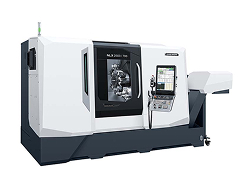
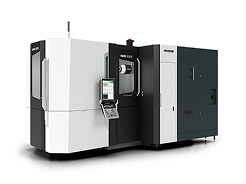
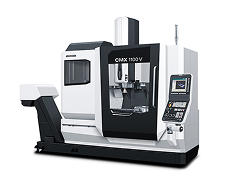
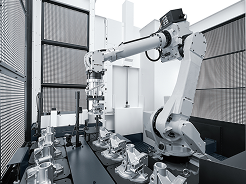
The manufacturing process for target materials consists of a primary machining process using a general purpose lathe, a secondary machining process on a numerically-controlled (NC) lathe, hole drilling and grooving on a machining center (MC), and finishing with facing work using the NC lathe. Fuji Metal has succeeded in integrating and automating a process that originally took three operators working at three machine tools to complete by incorporating the use of a multi-axis machine and a robot.
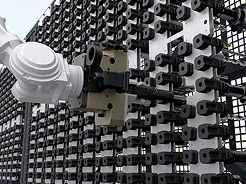
The company achieved this by integrating what was originally three separate processes - the secondary machining process on an NC lathe -> hole drilling and grooving with an MC -> finishing work using the NC lathe - through the introduction of a multi-axis machine. Reducing the number of machines required for this process to one also cut down on factory space to some 70%. Robot operation also allowed for unmanned operation at night and on weekends, increasing productivity by 50%. “While it is a massive investment for an SME such as ourselves, we have boosted our production capacity, to two-and-a-half times, by extending operating times to around 20 hours a day,” responds President Fujii, showing confidence in his decision.
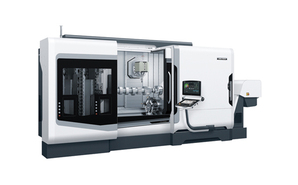
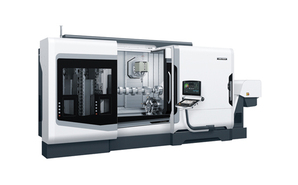
Multi-axis machine NT4300/1500 DCG + robot system
However, achieving this process integration was apparently no easy task for Fuji Metal.
The automated system in place today was completed through countless trial-and-error attempts. (Continued in Vol. 2)
- Learning from the Masters of Multi-axis Machine and Robot Applications vol.1
“How was Fuji Metal able to achieve such staggering levels of productivity?” - Learning from the Masters of Multi-axis Machine and Robot Applications vol.2

“Three Barriers Overcome on the Road to Process Integration” - Learning from the Masters of Multi-axis Machine and Robot Applications vol.3
“What ideals lay ahead of process integration?”
| Contact | Fuji Metal Co., Ltd. 2-7-16, Hinode, Kawasaki-ku, Kawasaki City, Kanagawa, 210-0824, Japan |
|---|---|
| URL | http://www.fuji-metal.co.jp/index.php |
This content is for members only