研磨中心機

立式多流程研磨機器

小型立式研磨機器

深孔研磨機器

內部研磨機器

螺紋研磨機器

CLOSE

客戶案例範例

  • 客戶案例範例 2018/12/17 UP
  • Print

Nakahara Works Co., Ltd.

Ask the Master of
“Parts Machining” x “5-axis Control Machine” Vol.1
Why did they choose 5-axis control machine for machining mass production parts?

シェア

Why did they choose 5-axis control machine for machining mass production parts?

Nakahara Works, specialized in rolling, boasts the top share of the roller market in Japan. A roller is a key component of printing machines such as a rotary press. As rolling requires high accuracy to ensure balance for stable and high-speed rotation, the company employs a technology called pressure welding to connect pipes and axes. They used to use a portal type 5-axis machining center to manufacture printer parts, but now employs a simultaneous 5-axis control machine. “In my thought, we did not need a simultaneous 5-axis control machining center because what we were handling at the time were mass-production parts,” recalls President Kenichi Nakahara. Then what brought him to change his mind?
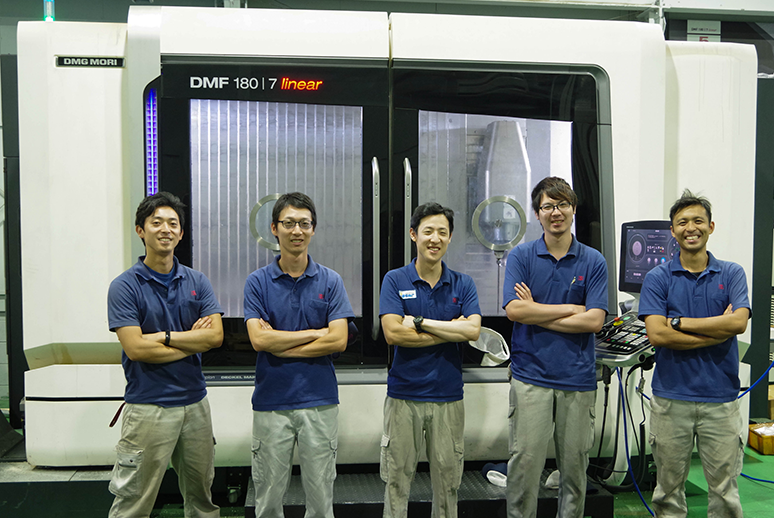
(From left) Mr. Kotaro Nakahara(Director / Chief of production department), Mr. Kentaro Nakahara(Director / General manager of development and technology department), Mr. Yuto Doi, Mr. Tatsuya Omori and Mr. Ryunosuke Kajiyama(Production department) in front of the DMF 180|7 linear

It was when he visited the DMG MORI Iga factory about three years ago. In the factory, a number of simultaneous 5-axis control machines were lined up to produce machine tool components. It was not just simultaneous machining that caught his eyes. In front of him were 5-axis control machines capable of multi-faceted cutting, and he was impressed how efficiently process integration was achieved. He was then convinced that a 5-axis control machine would be beneficial for general part machining.

From 3-axis machine to 5-axis machine – Approaches to process integration –

Before they were using several 3-axis control machines, and in 2016, Nakahara Works installed its first simultaneous 5-axis machine in hope that process integration by the new machine increases their shop productivity and machining accuracy. Now they use five units of 5-axis control machines. Nakahara Works also had been proactively introducing multi-axis machines. And the spirit of “looking ahead” and their know-how on multi- axis machines led to the introduction of the 5-axis machine. “Our 5-axis control machines are in full operation, and we are working on process integration. We will see how much we can achieve,” says President Nakahara.

The use of simultaneous 5-axis control machines may be considered limited to highly difficult parts machining such as complex-shaped dies and molds and impeller shafts for aircrafts. In Japan, 5-axis machines are mostly being used by manufacturers at the top tier of the industry. However, Nakahara Works employed the machine in an effort to verify the advantages of using it for general parts machining. “As we have used 3-axis control machines by now, 5-axis control machines are not necessary yet. That’s what most of us were thinking. On the other hand, I was asking myself if we should stay where we are in the times when technologies progress at an exponential speed,” says Mr. Kotaro Nakahara a second son of President Nakahara and Director / Chief of production department.

Nakahara Works was founded by Mr. Kiyoshi Nakahara, father of President Nakahara, in 1948. The company’s turning point is 1961 when President Nakahara was born. A leading manufacturer and one of their main customers began manufacturing offset printers, and it brought Nakahara Works into the parts production for printing machines. Since then, the printing machine market had expanded along with an increasing number of newspaper issues for half a century, and rollers for printing machines became the company’s main business. Then the collapse of Lehman Brothers took place in 2008, and they faced the turning point again. The company experienced a sharp drop in orders, and the sales of printing machines fell to half the amount. The future of newspaper never seemed bright because of advancement of the new digital era, and that was why they started expanding business. Such a management environment of the company was one of the driving factors of their introducing a simultaneous 5-axis control machine.

Mr. Kotaro Nakahara, Director / Chief of production department

Avenue for business expansion achieved by 5-axis control machine

With the techniques and skills honed by the experience of producing rollers for printing machines, the company started to expand their reach to rollers for film manufacturing devices. Their business continues to expand toward the fields of parts machining for food processing machines, industrial robots and aircrafts. “The printing machine-related business used to account for 96% of our business, but now it is down to 62%. The decline is due to a great expansion of other businesses. The fact that our operators can use the 5-axis control machine is a huge contributor to business expansion as well,” President Nakahara shows confidence.

DMU 210P with a stable portal type structure and the operator

Contact: Nakahara Works Co., Ltd.
463, Otami, Naka-ku, Okayama City, Okayama 703-8228, Japan
URL https://www.nkhr.info/

This content is for members only

The bookmark function is a service restricted to members.
To use it, you must register as a member and log in.